

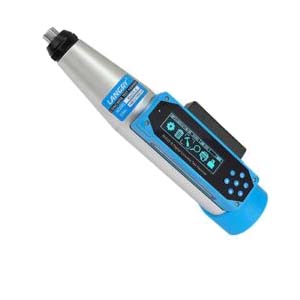
The digital Schmidt hammer is a widely used non-destructive testing tool designed to estimate the compressive strength of concrete by measuring its surface hardness. By recording the rebound of a standardized impact, this instrument provides valuable information on the quality and uniformity of concrete and is extensively used in construction projects, quality control, and structural assessments.
The hammer operates by measuring the energy returned from an impact. A spring-loaded plunger strikes the concrete surface with a known force, and the amount of rebound—dependent on the concrete’s surface hardness—is measured as the Rebound Number (R-value).
Higher rebound values indicate denser and harder concrete, which corresponds to higher compressive strength. Using standardized calibration curves or tables, the rebound number can be converted to approximate compressive strength (MPa or N/mm²).
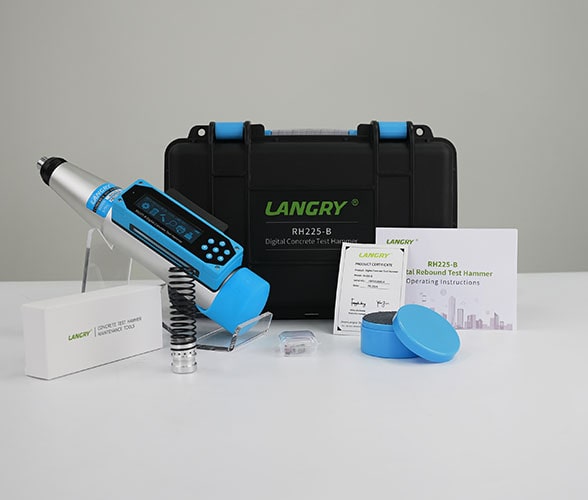
Convert the average to compressive strength using calibration curves or device calculations
Prepare the concrete surface:
The surface must be smooth, clean, and free of paint, coatings, or loose particles.
Turn on the device:
Select the relevant standard (e.g., ASTM, EN).
In digital models, impact direction (vertical/horizontal) can be automatically recognized.
Position the hammer:
Place the instrument perpendicular (90°) to the surface.
Apply the impact:
Press the hammer against the concrete until a click is heard.
The rebound value is displayed digitally.
Repeat measurements:
Take at least 10–12 impacts per testing area.
Maintain proper spacing and avoid edges or steel reinforcement.
Process data:
Discard outliers and calculate the average of valid rebound numbers.
Use in laboratories and construction sites for quality assurance
Non-destructive estimation of concrete compressive strength
Quality control of freshly cast concrete
Assessing uniformity in existing structures
Evaluation of concrete in bridges, tunnels, and buildings
Non-destructive estimation of concrete compressive strength
Quality control of freshly cast concrete
Assessing uniformity in existing structures
Evaluation of concrete in bridges, tunnels, and buildings
Use in laboratories and construction sites for quality assurance
Results depend on surface condition, moisture, and concrete age
Suitable for preliminary strength estimation, not a replacement for destructive tests
For higher accuracy, results should be confirmed with core testing
Periodic calibration is required to maintain accuracy
The digital Schmidt hammer is a fast, reliable, and non-destructive tool for estimating concrete compressive strength. Its ease of use, quick measurements, and non-invasive nature make it an essential instrument in construction projects, quality control laboratories, and structural assessments.
