
Description
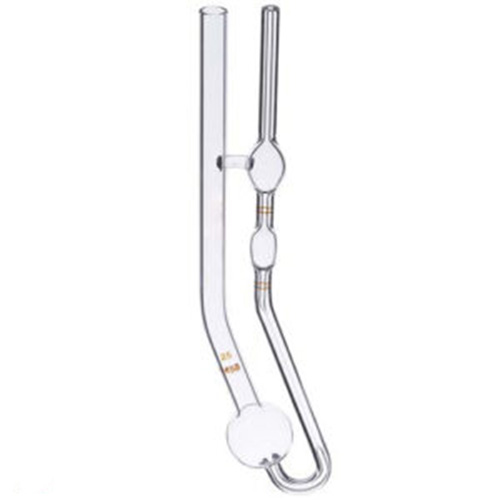
Fenske Viscometer
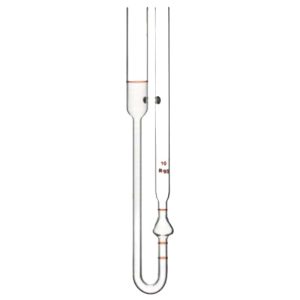
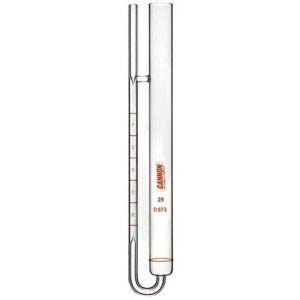
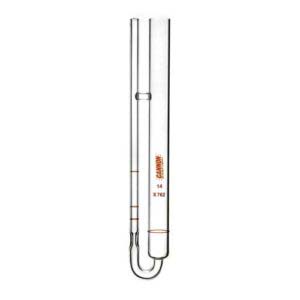
The Fenske Viscometer is a type of glass tube widely used for measuring the viscosity of fluids.
Concept of Viscosity
Viscosity refers to a fluid’s resistance to flow. A low-viscosity fluid flows easily (e.g., water), while a high-viscosity fluid resists flow (e.g., honey at room temperature or bitumen at 80–90°C). Understanding viscosity also requires familiarity with Newtonian and non-Newtonian fluids.
Newtonian vs. Non-Newtonian Fluids
-
Newtonian fluids: Viscosity remains constant regardless of temperature (e.g., water).
-
Non-Newtonian fluids: Viscosity changes with temperature. For example, bitumen behaves almost solid at 25°C but becomes less viscous than water at 135°C.
Glass viscometers are designed to calculate viscosity under controlled conditions easily. Among them, the Fenske Viscometer is particularly popular for measuring the viscosity of transparent fluids, such as oils.
Typical Applications:
-
Measuring kinematic viscosity of oils and lubricants
-
Standard testing at 40°C and 100°C
-
Selection of viscometer size based on fluid viscosity and type of oil
The Fenske Viscometer is a reliable tool for laboratories and quality control centers to determine fluid behavior under specified temperature conditions.

-
Main Applications of the Fenske Viscometer
-
Measurement of viscosity for various oils and lubricants
-
Testing transparent fluids up to approximately 100,000 mm²/s (cSt)
-
Determination of fluid flow behavior at reference temperatures of 40°C and 100°C
-
Quality control tests in oil, refinery, automotive, and chemical industries
-
Use in standard laboratories, R&D units, and calibration centers
Features and Advantages of the Fenske Viscometer
-
Full compliance with national and international standards
-
Comes with a calibration certificate
-
Affordable and cost-effective
-
High-quality construction with consistent tube uniformity
-
Made of heat- and shock-resistant borosilicate glass
-
Suitable for low to very high viscosity fluids
-
Fast delivery even for small quantities
-
Safe and standard packaging to prevent breakage
Testing Method and Operation
The Fenske Viscometer is a precise reference tool for measuring the viscosity of transparent fluids. Manufactured according to international and national standards, it is widely used in oil, lubricant, petrochemical, chemical industries, and quality control laboratories.
Procedure:
-
Set the viscosity bath to the desired temperature (40°C or 100°C).
-
Fill the viscometer tube with a specified volume of the fluid.
-
Place the tube in the bath to achieve thermal equilibrium.
-
Allow the fluid to flow through the capillary under equilibrium conditions.
-
Start a stopwatch as the fluid reaches the first mark and record the time to reach the second mark.
-
Multiply the measured time by the tube constant (from the calibration certificate) to calculate the kinematic viscosity:
ν=C×t\nu = C \times tν=C×t
Where:
-
ν\nuν = kinematic viscosity (mm²/s)
-
CCC = tube constant
-
ttt = flow time (seconds)
This method is highly accurate and repeatable, making it recommended in international standards.
Guide to Selecting the Correct Tube Number
-
Sample viscosity range
-
Type of fluid (oil, solvent, additive, etc.)
-
Test temperature (40°C or 100°C)
-
Required laboratory accuracy
Advantages of Purchasing from Our Collection
-
Standard Fenske viscometer with valid calibration certificate
-
Guaranteed quality at competitive prices
-
Fast supply and full stock of different tube numbers
-
Expert support for selecting the correct tube
-
Suitable for quality control, industrial, standard, and educational laboratories
labs, and research centers.
-
Reviews
There are no reviews yet.